Powdery Mildew on Cucumbers: 3 Causes and What to Do
Four of 18 cucumber leaves showing talcum-like patches at first flower is the point where action still pays. Remove the worst leaves, open the canopy, and watch the newest growth; trying to scrub every white mark from an already infected plant wastes time. Powdery mildew on cucumbers can spread during warm weather with humid nights even when you water carefully, because this group of fungi can infect leaf surfaces without a film of water sitting on them.
Start by confirming the pattern. True powdery mildew forms white, floury colonies on the upper leaf surface, then may spread across stems and leaf undersides. If the mark wipes away like dust but leaves a green leaf underneath, it may be residue. If the leaf has angular yellow patches bounded by veins and a grey-purple growth below, compare it with Downy mildew on cucumbers: how to tell it from powdery mildew before treating. Fine stippling, webbing, and bronzed leaves point you toward spider mites instead.
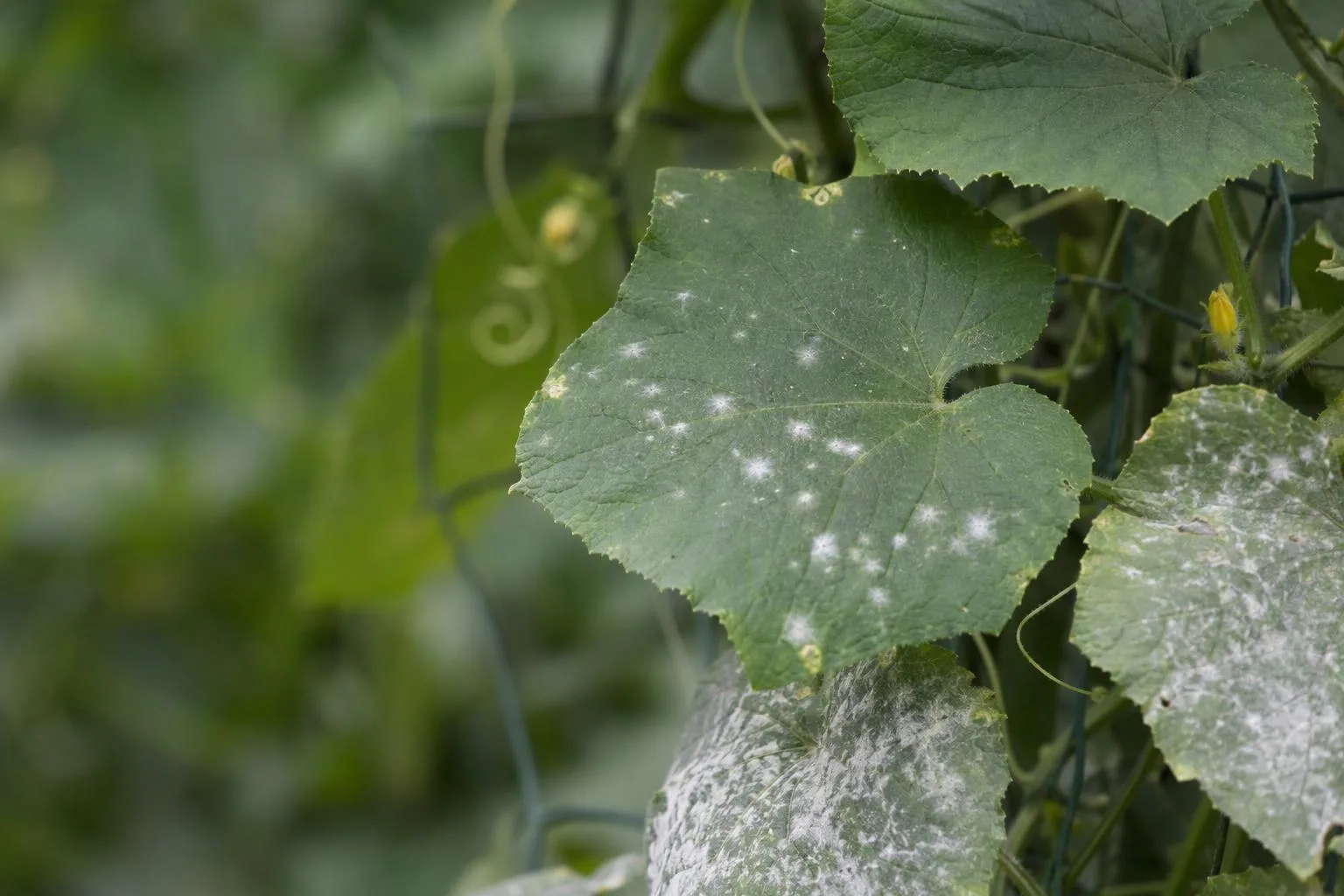
Act early: confirm powdery mildew before you start spraying
The first useful distinction is between a surface colony and a damaged leaf. Powdery mildew looks like separate white spots at first, often on the upper side of older leaves. Those spots enlarge into irregular patches and can merge. The leaf may remain green around the colony, though badly affected leaves eventually yellow, curl, dry, and contribute less energy to the plant.
Choose one representative leaf and inspect both sides in daylight. A cottony or flour-like coating that sits on the tissue supports the powdery-mildew diagnosis. Downy mildew usually begins with pale yellow or olive areas constrained by leaf veins; the underside can develop a darker fuzzy growth when humidity is high. Soil splash, hard-water deposits, and dried foliar sprays tend to follow droplets or rub off in a more uniform film. Mite injury produces many tiny pale feeding marks rather than a continuous white fungal mat, and a hand lens may reveal mites or fine webbing.
Use this first response while the diagnosis is still fresh:
- Mark the infected leaves with a piece of tape or count them.
- Remove leaves with broad, established colonies. Cut the petiole cleanly rather than tearing the leaf and shaking spores through the canopy.
- Place the material in a bag or covered bin. Keep it out of the working path around healthy cucumbers.
- Separate crowded vines, tie them to the trellis, and remove only leaves that are infected, dead, or blocking the plant centre.
- Inspect new growth every day or two for the next week. A treatment decision should be based on whether fresh colonies appear, not on whether old white patches vanish.
That last point matters. Fungicides and biological products may protect new tissue or slow expansion, but they cannot restore a leaf whose photosynthetic surface is already coated or dead. The practical target is the next flush of leaves.
For a concrete example, imagine a cucumber at first flower with 18 mature leaves and four showing small colonies, each affecting less than a quarter of its surface. Remove those four leaves if the plant still has plenty of healthy foliage, then tie the vine so its remaining leaves are separated. If the next three new leaves stay clean for several days, spraying may add little. If two fresh leaves develop colonies during that inspection window, the outbreak is active and a labelled treatment becomes more defensible. The same count would lead to a different decision on a plant with only six leaves: removing four would remove most of its photosynthetic capacity, so harvestable fruit and new growth would become the priority.
The three conditions that turn a few spores into a cucumber problem
Calling powdery mildew a watering mistake gives you a narrow and often wrong remedy. Three practical conditions usually have to meet: spores arrive, the canopy gives them a workable microclimate, and the host remains susceptible or stressed while the weather favours growth.
1. Spores arrive from somewhere nearby
Powdery mildew colonies produce airborne spores. They can move between cucumbers, squash, melons, volunteer cucurbits, and susceptible weeds. That means a clean bed can develop symptoms even when the soil was fresh and the leaves were kept dry. A neighbouring plant, an overlooked volunteer, or an older cucumber at the far end of a trellis may be the source.
Sanitation still has a role, but it has a limited one. Removing infected leaves reduces the material producing spores inside your own canopy. It does not create an invisible barrier around the bed. Treating the soil as the main reservoir can therefore send effort in the wrong direction for this disease pattern.
2. The canopy holds humid, still air
Cucumbers have large leaves and a fast-growing habit. Once several stems overlap, the air immediately around the leaf surface can remain humid after the surrounding garden feels dry. A trellis helps only when it actually separates leaves from one another; a tangled wall of vines can be just as stagnant as a sprawling patch.
Spacing is a design decision made before symptoms appear. The right distance depends on cultivar, trellis, local wind, and whether you can reach the centre of the plant without brushing every leaf. For the planning details, see How far apart to plant cucumbers for airflow and disease prevention. As a working example, two plants grown on a narrow vertical support need less horizontal bed width than two sprawling plants, but they still need enough room for leaves to hang on separate planes rather than forming a single wet-looking curtain.
3. A susceptible or stressed host meets favourable weather
Powdery mildew does not require leaves to stay wet for infection in the way many water-dependent leaf pathogens do. Warm days, humid nights, shade, and crowded growth can give colonies repeated opportunities. Drought stress, root restriction, nutrient imbalance, and heavy fruiting can also reduce the plant’s ability to produce vigorous replacement growth.
Excess nitrogen adds another complication. It can push soft, leafy growth that thickens the canopy and increases the amount of susceptible tissue. That does not mean a nitrogen feed directly creates mildew, nor does it justify starving the crop once symptoms appear. The better question is whether the plant is making rank growth because the feed rate, light level, and available root space are out of balance.
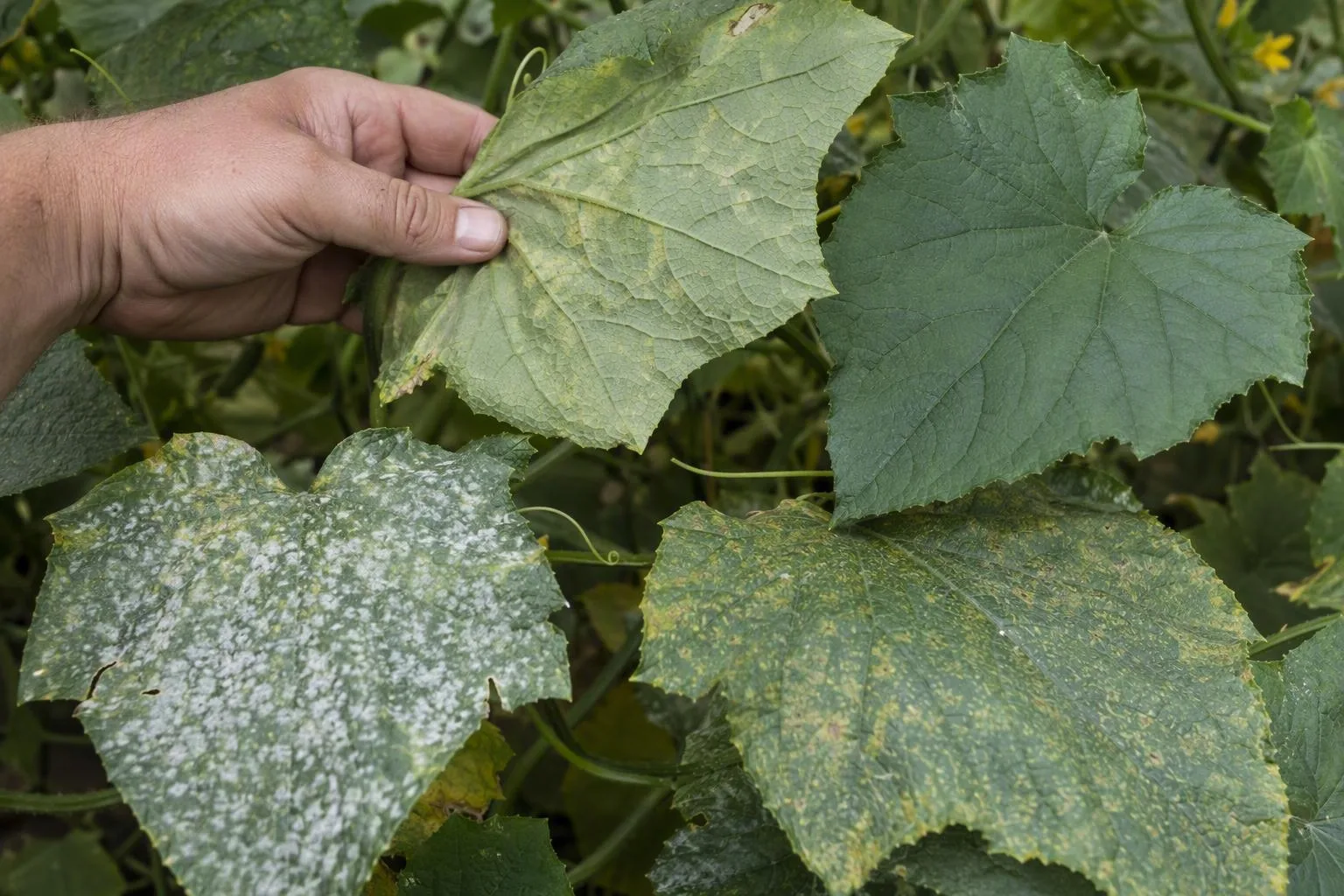
Do not use humidity as a single-number diagnosis. A damp night followed by a breezy morning may produce a different outcome from a still night inside dense foliage. Check the plant’s actual microclimate: are leaves touching, is the centre shaded all day, and does the vine dry slowly after irrigation? Those observations tell you more than a weather-app percentage.
A treatment sequence that matches the stage of infection
Treatment works best as a sequence rather than a product hunt. First remove the leaves that are carrying substantial colonies. Next fix the canopy and the root-zone stress. Then consider a labelled product if new infections continue. Spraying a crowded, drought-stressed plant without changing its growing conditions often produces a clean-looking product label and a disappointing plant.
When leaf removal is enough
Removal makes sense when the plant has ample healthy foliage and the colonies are limited to a manageable number of leaves. Use clean secateurs, cut at the petiole, and disinfect tools between visibly affected plants if you are moving through a collection. Avoid stripping every leaf with a faint spot. Cucumber fruit depends on the remaining canopy, and excessive defoliation exposes fruit and growing points to heat and sun stress.
In the 18-leaf example, four lightly affected leaves can be removed without turning the plant into a bare stem. If 12 of those 18 leaves were heavily covered, the arithmetic changes: removing all of them may slow the plant more than it slows the disease. Harvest mature fruit, preserve enough green leaf for continued growth, and decide whether the crop has reached the point where replacement is more sensible.
How the main treatment groups differ
| Option | Best role | Where it quietly fails |
|---|---|---|
| Sulfur | Early protection or suppression when the product is labelled for cucumbers | It can injure foliage in heat, and it should not be combined with horticultural oil. |
| Horticultural oil | Early colonies and surface suppression under suitable conditions | Coverage, temperature, and plant sensitivity control the result; heat and recent sulfur use raise injury risk. |
| Potassium bicarbonate | Preventive or early-stage protection with thorough coverage | It is not a reset button for leaves already covered in mildew, and residue or leaf injury is possible if used incorrectly. |
| Biological products | Preventive programmes and repeated protection where label directions fit | They generally need good timing and coverage; severe established colonies are a difficult job for any soft product. |
This is a role-based comparison, not a promise that one category will outperform the others in every garden. Read the label for the exact crop, disease, rate, interval, application method, and safety directions. The product label controls permitted crop use, application rate, re-entry interval, and preharvest interval because those instructions define how the registered product is to be used.
For edible cucumbers, use only a product labelled for cucumbers and observe its harvest interval and protective-equipment instructions. Do not mix sulfur and horticultural oil, and do not apply either during weather hot enough to burn foliage or during any temperature window prohibited by the label. If a product has been applied, follow its stated preharvest interval rather than relying on smell, drying time, or a quick rinse.
Potassium bicarbonate deserves a careful distinction from kitchen baking soda. Both are bicarbonate salts, but a household recipe has no dependable crop label, rate, surfactant compatibility, or crop-safety instruction behind it. Sodium bicarbonate may help as a limited preventive measure in some home formulations, yet the margin between useful coverage and leaf injury is narrow. A labelled potassium bicarbonate product gives you a crop-specific direction to follow; it still cannot cure tissue that has already collapsed.
Apply any protectant for coverage, not for dramatic colour change. Undersides, petioles, and the inner canopy are easy to miss, but a wet-looking outer leaf does not prove the target surfaces were covered. Repeat only at the interval permitted on the label. More product or more frequent spraying is not a substitute for a better canopy.
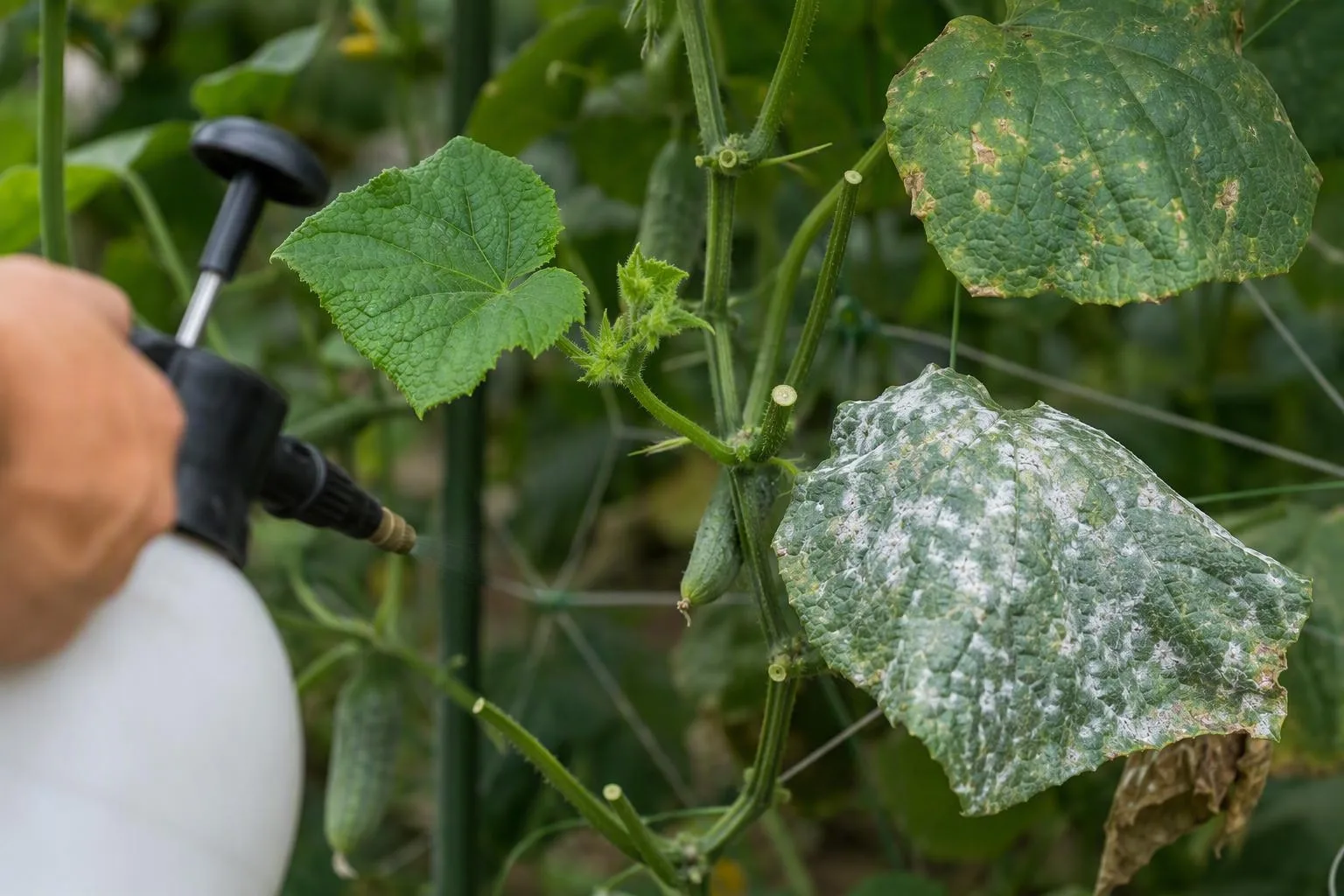
Prevent the second wave: canopy, cultivar, and end-of-season decisions
Next season’s strongest intervention may happen before the seed packet is opened. Choose a cucumber described as resistant or tolerant to powdery mildew, while checking the specific variety information rather than assuming every cucumber in a resistant series performs identically. Resistance reduces the chance or severity of disease under pressure; it does not make the plant independent of spacing, nutrition, or weather.
Pair that choice with a trellis that keeps leaves distributed. Train young vines while stems are flexible. Remove a badly infected lower leaf or a dead leaf that blocks airflow, but avoid the common overcorrection of stripping side leaves simply to make the plant look tidy. Leaves are the crop’s energy system. The aim is an open, functional canopy, not an empty trellis.
Water the root zone deeply enough to prevent repeated wilting, preferably early enough that the surrounding bed can dry before night. Drip irrigation or a directed hose can reduce unnecessary wetting, but changing the watering method alone will not prevent powdery mildew because infection does not depend on free water on the leaf. It can still improve the wider canopy environment and reduce stress.
Feed according to the crop and soil rather than responding to every pale leaf with nitrogen. If growth is lush, soft, and tightly packed, pause before adding more nitrogen. A soil test, reasonable compost application, and attention to root volume are more useful than guessing from leaf colour. This is a judgement call rather than a universal fertiliser rule: a genuinely hungry plant needs nutrition, while a crowded vine with dark, excessive foliage needs room and restraint.
At the end of the crop, remove infected vines instead of leaving them to collapse on the trellis. Bagging or covering the material before it leaves the bed reduces handling and keeps loose plant debris from being redistributed around the plot. Because spores travel through air, end-of-season cleanup is a pressure-reduction step, not a guarantee that the next crop will begin clean.
The straightforward call here is to match the response to the plant’s remaining value. Keep treating and training when new growth is vigorous, the infected area is limited, and cucumbers are still forming. Harvest promptly and stop investing in repeated sprays when most useful leaves are affected, fruit production is fading, or the label’s harvest interval makes the treatment schedule impractical. For a short-season garden, replacing a failing plant with a resistant variety may produce more food than trying to preserve a collapsing vine.
Save the checklist below for the next inspection:
- Confirm floury colonies rather than assuming every white mark is mildew.
- Count affected leaves and compare that number with the plant’s healthy canopy.
- Remove heavily colonised leaves, then separate touching vines.
- Inspect new leaves after the canopy correction.
- Use a cucumber-labelled product only when active spread justifies it.
- Record the variety and remove the vines after harvest.
Three questions that change the decision
Can you eat cucumbers from a plant with powdery mildew?
Powdery mildew on leaves does not automatically make a sound cucumber inedible. Harvest firm, undamaged fruit, wash it before eating, and discard fruit that is rotten, split, or otherwise damaged. If the plant was treated, follow the product’s preharvest interval; that interval takes precedence over a visual judgement that the spray has dried.
Does watering cucumber leaves cause powdery mildew?
Leaf wetting alone does not explain powdery mildew infection. The fungus can establish without a persistent film of water, although a dense, humid canopy and poor drying can worsen the overall disease environment. Direct irrigation toward the soil mainly helps by reducing plant stress and keeping the canopy easier to manage.
Will baking soda cure powdery mildew on cucumber plants?
Household baking soda is better treated as an uncertain, early-stage or preventive option than as a cure. It may injure leaves when the concentration, weather, water quality, or spray interval is wrong, and it will not return heavily coated tissue to health. A labelled potassium bicarbonate product gives clearer directions, but even that product works by protecting or suppressing susceptible tissue rather than erasing established damage.
Once the current crop is finished, the next decision is simple but consequential: reserve space for a resistant cucumber with a genuinely open canopy, or repeat the same crowded planting and ask a spray to compensate for the design.
Frequently Asked Questions
Can you eat cucumbers from a plant with powdery mildew?
Explain that mildew on leaves does not automatically make the fruit unsafe, but readers should harvest sound cucumbers, wash them, discard damaged or rotten fruit, and follow any pesticide label harvest interval if a treatment was applied.
Does watering cucumber leaves cause powdery mildew?
Clarify the distinction between powdery mildew and many leaf diseases: free water is not required for powdery mildew infection, although irrigation that keeps the canopy humid or causes prolonged wetness can worsen the broader disease environment.
Will baking soda cure powdery mildew on cucumber plants?
Position sodium bicarbonate as a sometimes-useful preventive or early-stage treatment with a narrow margin before leaf injury, not a cure for established infection; distinguish it from labeled potassium bicarbonate products and advise following the product label.