What Is the 3-3-3 Rule for Mulch? The Safe Setup
Three inches of mulch, three inches of bare stem, and a ring about three feet across: that is the practical version of the 3-3-3 rule. Used around a young tree or shrub, it gives you a measurable starting layout. The catch is that “three feet” is sometimes used to mean a diameter and sometimes a radius, so say which one you mean before you spread anything.
For this guide, the ring is roughly 3 feet in diameter. Measure the mulch after it has been spread and lightly settled, keep the trunk flare visible, and treat the rule as a starting geometry rather than a law that overrides drainage, plant size, or material choice.
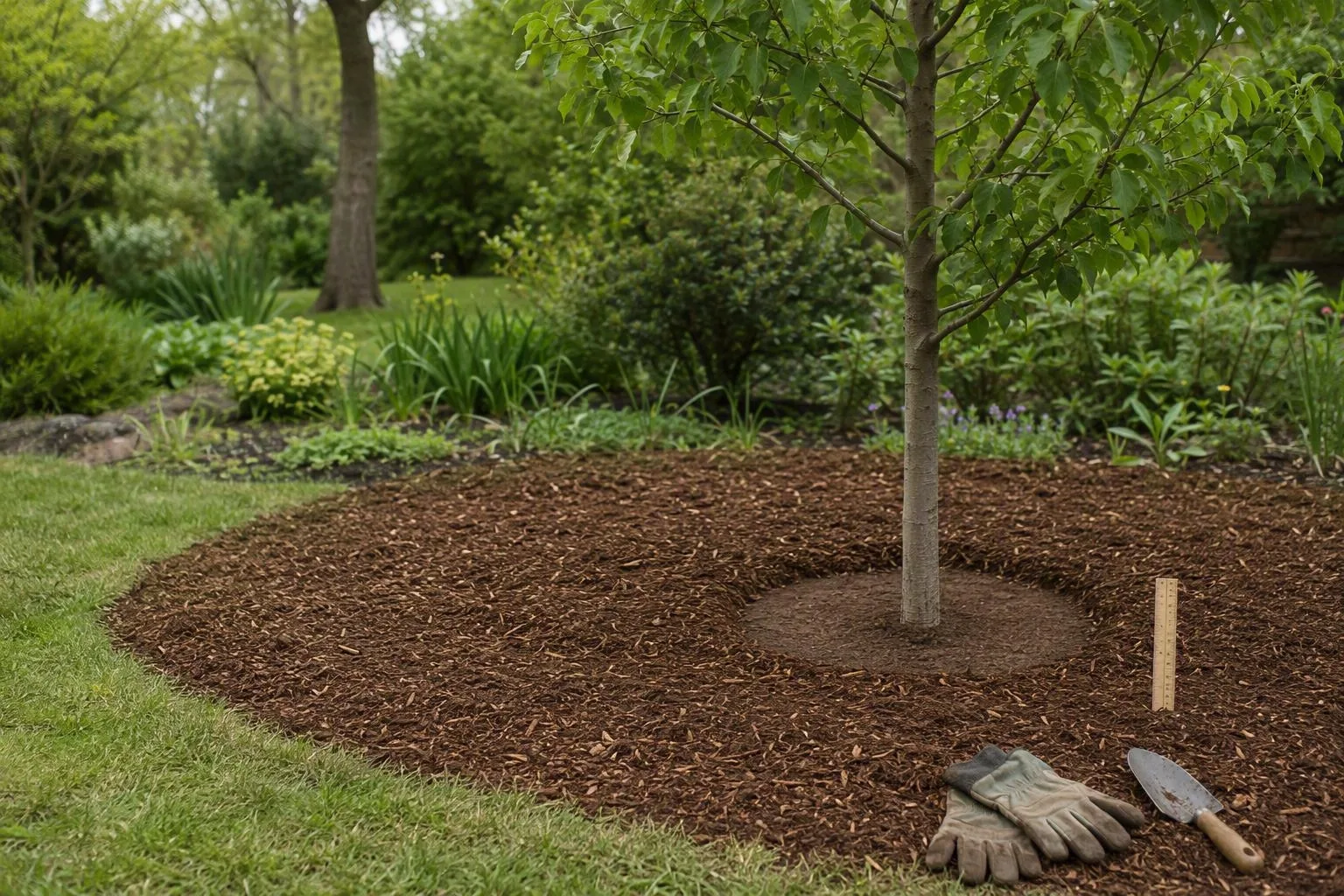
The 3-3-3 mulch rule means 3 inches deep, 3 inches clear, and a 3-foot-wide ring
The first “3” is the depth: apply approximately 3 inches of mulch across the useful root-zone surface. The second is the clearance: leave at least 3 inches between the mulch and a woody trunk, soft stem, or perennial crown. The final “3” describes the layout used here, a ring about 3 feet in diameter around a small tree or shrub.
That last measurement needs careful wording. A 3-foot diameter gives you a 1.5-foot distance from the trunk to the outer edge. If someone says “a 3-foot mulch ring” while measuring 3 feet outward from the trunk, they are describing a 6-foot diameter. Both usages occur in gardening conversations. The tape measure settles the argument.
For a young fruit tree, the ring is usually easiest to mark with a short stick or piece of string. Set one end near the trunk, measure 18 inches outward for a 3-foot diameter, and walk the circle before adding mulch. The trunk itself remains outside the mulch layer, with its root flare visible at ground level.
Searchers often ask, “What is the 3-3-3 rule for mulch?” The short answer is this: three inches deep, three inches clear of the plant, and approximately three feet across when you are mulching a small woody plant. It is a useful field shorthand, not a universal prescription for every bed.
Why the three measurements solve three different mulch problems
Depth controls the balance between coverage and air exchange. A layer of organic material shades the soil surface, slows evaporation, and reduces the temperature swings that occur in exposed soil. As mulch settles and decomposes, the layer becomes thinner and its effect changes. Starting near 3 inches gives coarse material some room to settle without immediately leaving bare patches.
The bare collar solves a different problem. Bark and young green stems stay damp longer when mulch touches them. That contact can soften the outer tissues, hide insects, and create a persistently humid surface around the stem. The clearance also lets you see the root flare and notice whether soil or mulch is creeping upward.
The ring width is about placement. Tree roots are not restricted to the small circle directly beneath the trunk. Fine absorbing roots occupy the upper soil and extend outward as the plant establishes. A ring that reaches beyond the planting hole gives the mulch a chance to moderate the soil where those roots are developing, while avoiding the temptation to bury the entire lawn or border.
Still, the three-foot geometry has limits. A newly planted whip may have a small root system, while an established shrub may already extend well beyond the proposed circle. Heavy clay that stays wet after rain needs a thinner, more breathable cover than a rapidly draining sandy bed. Shallow-rooted plants can also react badly if a thick layer is added over already wet soil.
That is why the ring deserves adjustment. If water stands around the plant, reducing the mulch depth and improving drainage is a more sensible response than defending the number. Guidance on mulch depth, trunk clearance, and root-zone moisture from University extension services is useful here, but the site conditions in front of you still decide whether the rule is suitable.
A 3-inch layer is not the same as three inches of settled mulch
Measure depth in three places: near the outer edge, midway through the ring, and on the side facing the prevailing rain or irrigation. Push a ruler vertically through the mulch until it meets the soil. Do not measure the tallest point of a pile. A cone can look generous while leaving the outer roots with a thin dusting.
Coarse wood chips contain air gaps, so a freshly spread layer may settle after rain. Fine shredded bark and leaf-based material settle more quickly and can hold water more tightly. The practical test is to check again after the first substantial rain, then top up only where the layer has fallen below your intended depth.
| Observed layer | What it tends to do | First adjustment |
|---|---|---|
| About 1 inch | Leaves exposed soil between pieces and gives short-lived suppression of weeds and evaporation. | Add material gradually if the surface dries quickly or weeds are emerging through gaps. |
| About 3 inches | Provides a useful cover while leaving more opportunity for air and water movement than a deep pile. | Check contact with stems and the depth after settling. |
| About 5–6 inches | Can stay wet, restrict oxygen movement near the surface, settle into a dense mat, and create sheltered habitat for pests. | Rake it back or remove excess rather than adding another layer. |
The table is a decision aid, not a promise that every material behaves at those exact depths. A fluffy, coarse chip layer and a compacted shredded-bark layer can measure the same while behaving differently. Fine material may need a shallower application because it closes air spaces and holds water more readily.
One quiet problem appears when carbon-rich material is mixed into soil. Soil organisms need nitrogen as they break down fresh woody material, and they can temporarily draw available nitrogen into their bodies near the mixing zone. That risk is more relevant when chips or sawdust are incorporated into the bed or worked into the planting hole. Surface-applied chips still decompose, but the main activity remains near the soil surface rather than throughout the root ball.
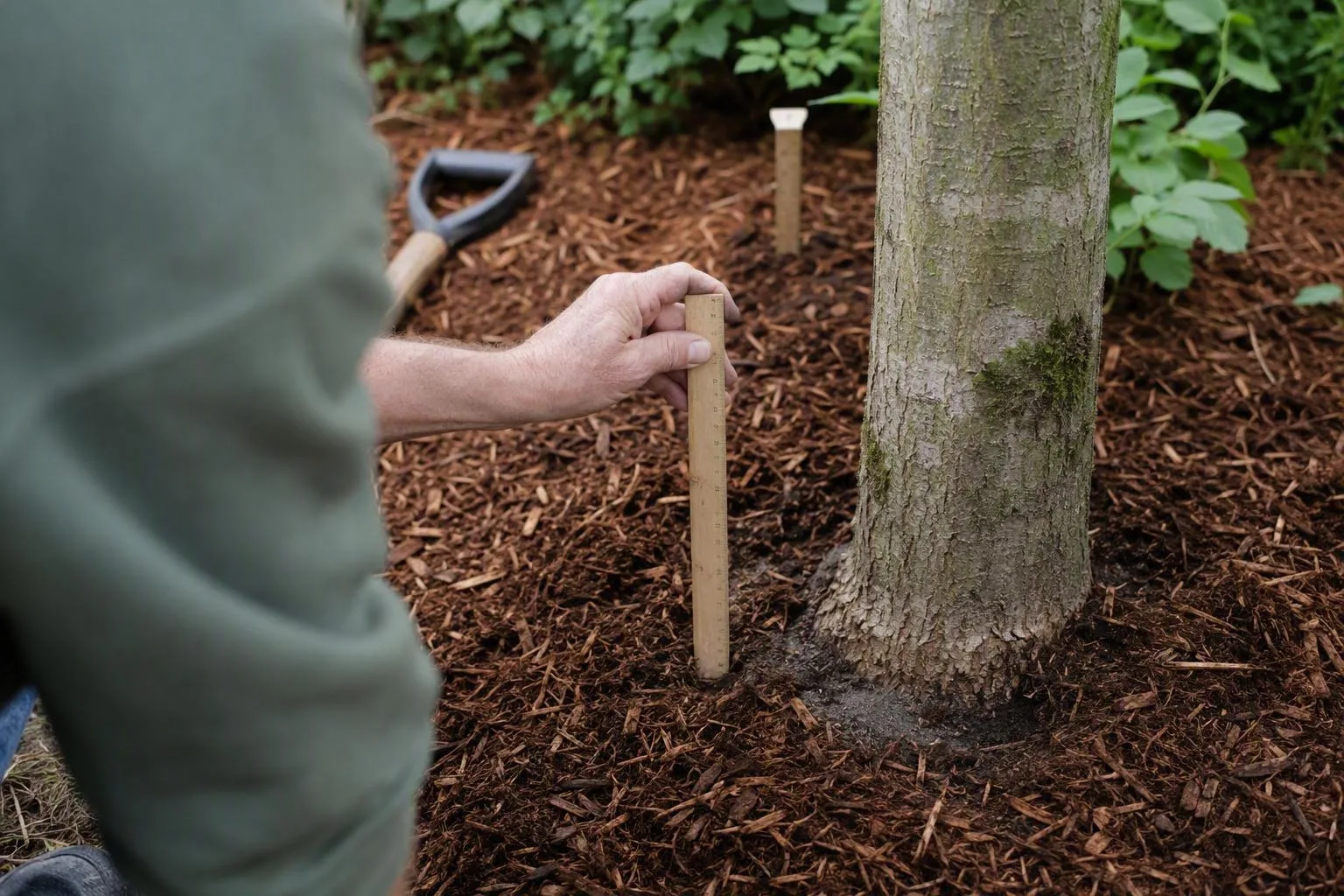
Build the ring without making a mulch volcano
One failure to check for first is the mulch volcano: a cone piled against the trunk instead of a flat ring. Its shape is easy to spot, but the more useful diagnosis is at the base. If the root flare disappears under mulch, pull the material back until the trunk widens naturally into roots.
- Clear the competing growth. Remove weeds or mow grass close to the surface. Work carefully around exposed roots; scraping them with a hoe creates a wound that mulch cannot repair.
- Water dry soil first. If the planting area is dusty and dry, water the soil before spreading the cover. Adding a thick dry layer and expecting later rain to wet the soil evenly can leave a hydrophobic or matted surface.
- Mark the ring. For the version described here, measure 18 inches outward from the trunk to create a roughly 3-foot diameter circle. Increase the radius when the plant and available bed justify it.
- Spread outward in a flat layer. Place mulch over the soil surface, keeping the center open. The top should resemble a shallow saucer or level collar, not a mound.
- Expose the flare and graft union. On a grafted fruit tree, keep the graft union above the mulch. Low branches should not be buried either; move the material away from any point where it stays wet against living tissue.
If an existing volcano is already in place, do not simply make the pile less steep. Pull mulch away from the trunk with gloved hands or a soft rake, then find the root flare. If the base is buried under soil as well, expose it gradually rather than excavating aggressively around large roots. A bare collar may look untidy for a week, but visibility is useful.
Exposed surface roots need a different compromise. Covering them with a thin, loose layer can reduce drying and mower damage. A deep mound can suffocate the fine roots you were trying to protect. Keep the material below the trunk flare and avoid packing it into the gaps between roots.
For a rough volume estimate, a circular 3-foot-diameter ring with a 3-inch layer needs approximately 1.77 cubic feet before settling if the circle is filled right across. In practice, the open collar reduces that amount, while uneven ground and settling increase uncertainty. Bag coverage varies by product, bag size, and whether the stated depth is loose or settled, so use the package coverage as a starting estimate and measure the finished layer.
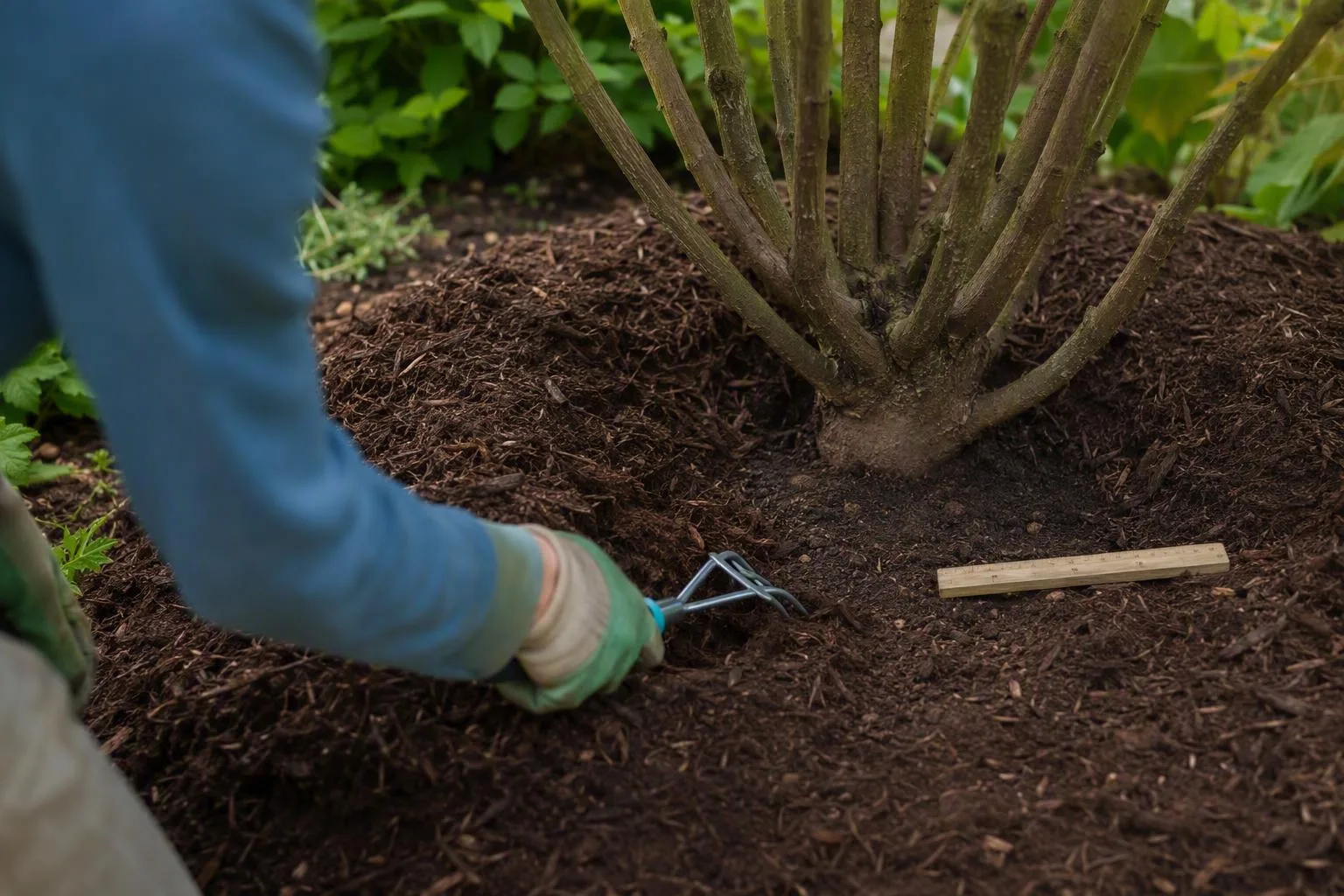
The rule changes at the vegetable bed, shrub border, and perennial crown
A vegetable bed does not need a three-foot circle around every plant. The useful part of the rule is the clearance around stems and the decision to measure depth. Lay mulch between rows or around established plants, leaving room around the stem base for inspection and airflow. Tender seedlings can be overwhelmed by a full-depth layer placed immediately after transplanting.
For a shrub border, the ring can be widened until it meets neighboring plants. If several shrubs are planted close together, a continuous mulched bed may make more sense than a series of small circles. Keep each crown and woody base visible even when the mulch field is continuous.
Perennials need crown clearance. A plant crown is the low point where leaves and stems emerge; burying it under wet organic matter can cause soft tissue to decay. Apply mulch in a narrow band around, rather than over, the crown. The exact gap depends on the plant's shape, but the decision is simple: if the crown stays damp and hidden, the material is too close.
Compost used as mulch deserves separate treatment. It is relatively fine, breaks down faster than coarse chips, and contributes nutrients as it decomposes. That makes it closer to a surface nutrient input than a long-lasting structural cover. A thin layer can be useful around established plants, while a deep layer over a wet crown or stem can create the same contact problem as other materials.
On heavy clay, poorly drained ground, or a site that receives frequent rain, start below the full 3 inches and inspect the surface. The point of mulch is to moderate the soil environment; adding a blanket that keeps the soil saturated defeats that purpose.
Choose the material before you choose the depth
Material changes the meaning of the number. Here is the judgment call I would make when choosing among common covers:
- Arborist wood chips: My preference for a broad tree or shrub ring when they are available clean and free of obvious diseased material. The mix of chips, bark, and leaves usually leaves larger air spaces than fine shredded products, though it settles and needs inspection.
- Bark mulch: A reasonable choice where a more uniform appearance matters. Larger pieces tend to shed water until they settle, so check whether rain is reaching the soil below.
- Shredded bark: I would apply this more cautiously than coarse chips because it can knit into a mat on a sloping or frequently irrigated bed. If water beads on top, rake the surface lightly rather than automatically adding more.
- Chopped leaves or leaf mold: Leaf mold is my choice when the goal is a soft, moisture-holding surface around established plants. Freshly chopped leaves can compact; use a thinner layer and inspect after rain.
- Straw: I regard straw as a seasonal vegetable-bed cover rather than a tidy permanent tree-ring material. It is light, can shift in wind, and may harbor seeds or shelter pests depending on its source and storage.
- Compost: Useful where feeding the surface is part of the plan, but too fine to treat as a permanent weed-suppressing blanket. Reapply based on what remains, not on the original depth.
Those are material judgments, not universal rankings. The same “wood mulch” label can describe dry chips, wet shredded bark, or a fine screened product, each with a different water and air profile.
Fresh woody mulch generally belongs on the soil surface. Mixing it into soil increases the contact between decomposers and the crop's root zone, which is where temporary nitrogen competition becomes more relevant. If plants show pale new growth after woody material has been incorporated, check soil fertility and root damage rather than assuming the mulch is the sole cause.
For edible crops, use fully composted manure or compost from a reliable source and follow local food-safety guidance. Avoid material that may contain persistent herbicide residues; some herbicides survive composting and can injure sensitive broadleaf crops. That is a sourcing and testing issue, not something the 3-3-3 geometry can fix.
For a closer comparison of two common woody options, see Wood Chips vs Bark Mulch: Which One Improves Soil Over Three Seasons? The material decision should come before you calculate how many bags to buy.
Check the ring after rain, winter, and one growing season
Mulching is a maintenance practice. Inspect the ring after a hard rain, after snow or frost has shifted the surface, and once the growing season has produced enough new growth to hide the base of the plant.
Use this order:
- Measure the settled depth in several places.
- Confirm that the 3-inch collar is still bare and that the root flare or graft union is visible.
- Push a finger or trowel through the layer to see whether water is reaching the soil.
- Look for a sour smell, black wet patches, a sealed surface, or fungal growth concentrated in a dense mat.
- Check for rodents or tunnels where a deep, undisturbed layer meets the trunk.
A thin spot does not require stripping the whole ring and rebuilding it. Add a light layer to the low area, then blend the edge so water does not run off the top. If the surface has matted, rake it open. If the soil remains saturated, remove material first and solve the drainage or irrigation problem before replacing it.
Mulch can also move uphill, wash downhill, or press against stems under drip irrigation. The ring you installed in spring may no longer be the ring you have in midsummer. That is why the most useful measure is not the initial pile; it is the settled depth and the condition of the collar.
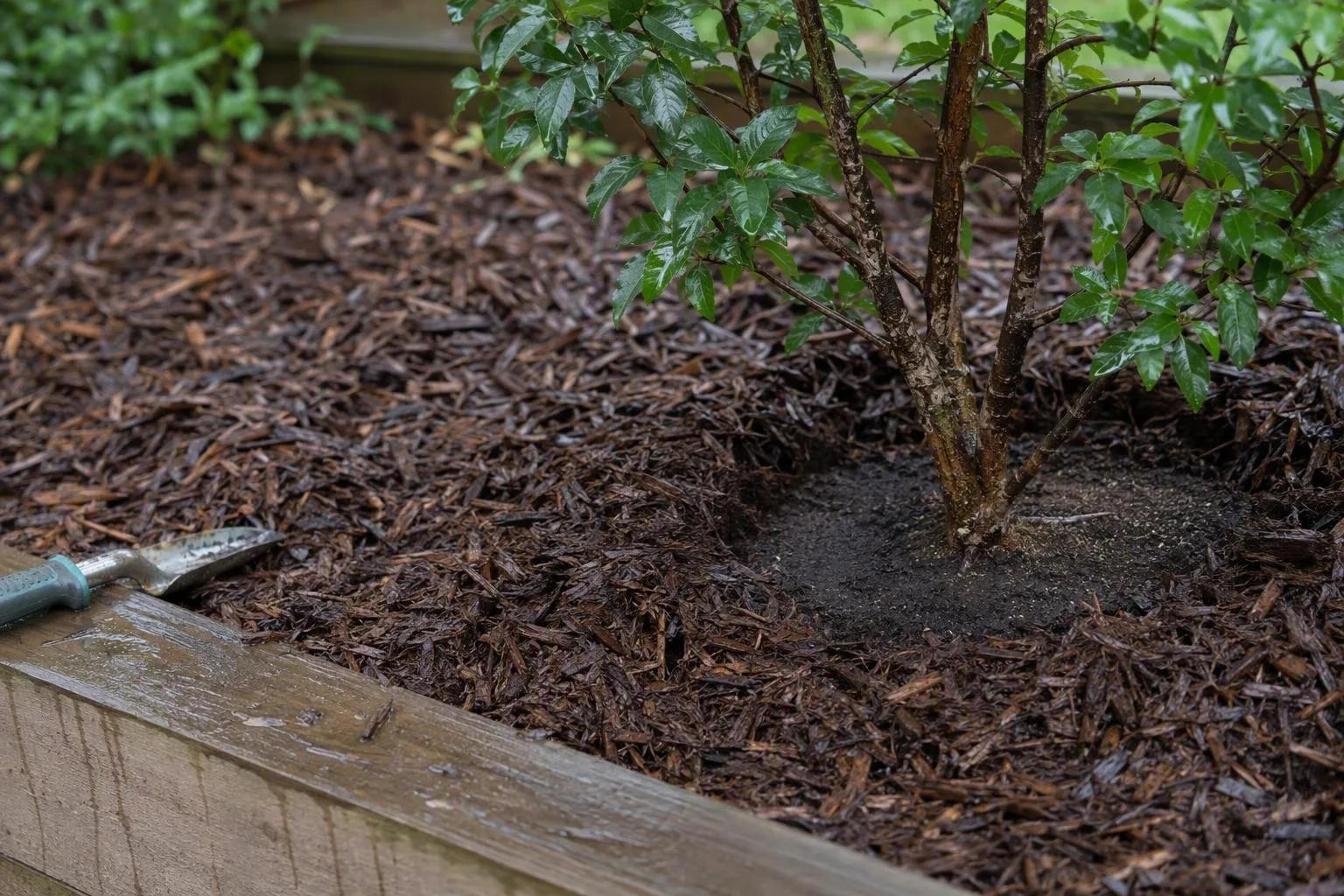
When the ring fails, name the failure precisely: depth, contact, coverage, or material. Depth calls for thinning or topping up. Contact calls for pulling material away. Coverage calls for extending or redistributing the ring. Material calls for replacing a matted or water-shedding product. Measure first, then make the smallest correction that restores the soil surface to a breathable, inspectable condition.
Three direct answers gardeners usually need
Does the 3-3-3 mulch rule apply to fruit trees?
It can be a useful starting layout for a young fruit tree. Keep mulch away from the trunk and graft union, leave the root flare visible, and reduce the depth if the soil is wet or poorly drained. As the canopy and root system expand, widen the mulched area rather than building the original ring higher.
Can fresh wood chips be used with the 3-3-3 rule?
They can be used as a surface mulch. Spread them flat, keep them clear of stems, and check for settling or matting. Avoid mixing a fresh woody layer into the soil around actively growing roots, where decomposers have more direct access to available nitrogen.
Should mulch touch plant stems or tree trunks?
No. Keep at least a small bare collar, with 3 inches as the practical version used in this rule. The gap gives the base of the plant air and makes it possible to see whether soil, mulch, or water is accumulating against living tissue.
The next decision is straightforward: measure the existing mulch ring before buying more. If it is too deep, too close, too narrow, or made from a material that has sealed over, the correct fix may be removal rather than another bag.
Frequently Asked Questions
Does the 3-3-3 mulch rule apply to fruit trees?
Usually it is a useful starting layout for young fruit trees, but keep mulch away from the trunk and graft union, avoid burying the root flare, and adjust depth for wet or poorly drained soil.
Can I use the 3-3-3 rule with fresh wood chips?
Yes, fresh chips are generally used as a surface mulch rather than mixed into soil; keep them clear of stems and watch for settling, matting, and temporary nitrogen competition at the surface.
Should mulch touch plant stems or tree trunks?
No. The safe version of the rule leaves at least a 3-inch bare collar because constant damp contact can damage bark and create conditions favorable to decay and pests.